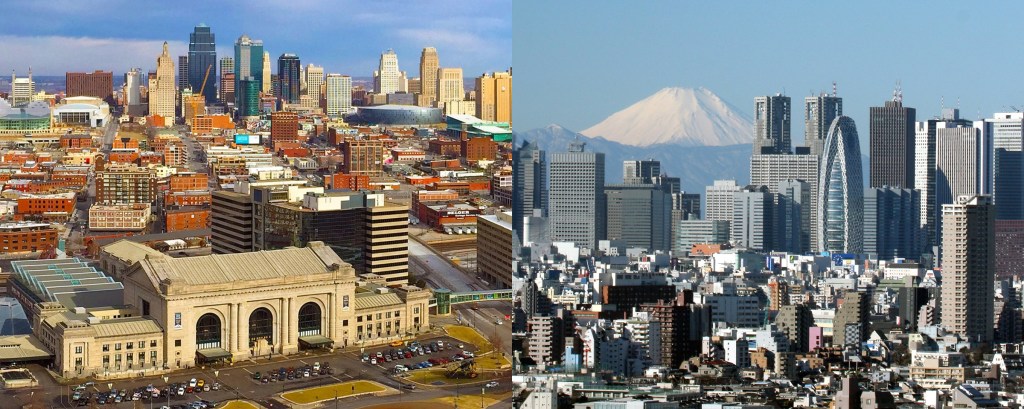
Our Level 3 students produced some great work this semester! This post focuses on the similarities and differences between Kansas City and Tokyo traffic.
While the distance between Tokyo and Kansas City is approximately 6000 miles (9600 kilometers), these two cities are quite similar.the historickansascity.org said, “Last decades of the 19th century were a time of prosperity that brought a building boom, …” Likewise, there is a good number of buildings which were built around 1900 in the urban areas of Tokyo. Moreover, both cities have four seasons and beautifully combined urban and green sceneries. Nevertheless, between these two cities, contrasts in traffic exist. This essay addresses the differences relating to traffic in Kansas City and Tokyo: kinds of transportation, the reasons for traffic jams, and traffic rules. (hisstorickansascity.org).
The first city to discuss is Kansas City. Most individuals use cars to commute to work and school every day. Therefore, many adolescents have their own cars. Trains are not exceedingly prevalent, but public transportation is developed such as free busses and the new transportation of a street car. Obviously, the most common reason for traffic jams is car accidents; for instance, hitting another car, crashing into a guardrail, and so forth. Each individual can turn right at the intersections during a red light if there is no car at intersections in Kansas City. Additionally, under the rule of Kansas City, every car even on the opposite side of the roads has to stop when police cars or ambulances drive by.
In the case of Tokyo, the most popular transportation is trains which even elementary school students use by themselves, and many individuals also use a bicycle a great deal for short distances, shopping, and so on. Since Tokyo has a large number of train tracks, there are many railroad crossings, and this is the most common reason for traffic jams. Due to safety, the railroad crossings are required to stop cars normally a few minutes before trains come through railroad crossings, which cause the lines of waiting cars that will become traffic jams. In addition, there are fewer traffic jams due to car accidents because roads in Tokyo are narrow and traffic lights are typically close to each other so that cars cannot drive fast much. In Tokyo, individuals drive on the left side of roads and are not allowed to turn at intersections under any circumstances when the traffic lights are red. The entertaining characteristic of crosswalks in Tokyo is that signals have music while the lights are green.
In conclusion, traffic aspects of Kansas City and Tokyo are quite different. In contrast, there are also similar aspects in these two cities such as the age of buildings. According to Lindsay Huth, Kansas City “grew by nearly 120,000 people between 2010 and 2017” in Kansas and Missouri, which means Kansas City will keep growing a great deal in the future so that Kansas City residents will be able to use the increasing convenience of public transportation of this metropolitan area. Therefore, the traffic conditions may change as Kansas City as the city changes such as the number of street cars increasing, but, in Tokyo, the number of subways might be developed more.
The right image of Tokyo’s skyline, created by Morio, was downloaded through the Creative Commons and was resized and cropped to fit this format.
 Applied Language Institute: The Blog
Leave a comment